A Word for Reading Matetrial in Order Yo Make a Decision
Reading comprehension is the ability to procedure text, understand its pregnant, and to integrate with what the reader already knows.[1] [2] Key skills required in efficient reading comprehension are knowing pregnant of words, ability to understand meaning of a give-and-take from soapbox context, power to follow organization of passage and to place antecedents and references in information technology, ability to draw inferences from a passage about its contents, power to place the main thought of a passage, ability to respond questions answered in a passage, ability to recognize the literary devices or propositional structures used in a passage and determine its tone, to understand the situational mood (agents, objects, temporal and spatial reference points, casual and intentional inflections, etc.) conveyed for assertions, questioning, commanding, refraining etc. and finally ability to determine writer's purpose, intent and point of view, and describe inferences about the writer (discourse-semantics).[3] [4]
There are many reading strategies to improve reading comprehension and inferences, including improving 1'southward vocabulary, critical text assay (intertextuality, actual events vs. narration of events, etc.) and practicing deep reading.[five] Power to encompass text is influenced by readers' skills and their power to procedure information. If give-and-take recognition is difficult, students employ too much of their processing capacity to read individual words, which interferes with their ability to cover what is read.
Overview [edit]
People larn comprehension skills through educational activity or instruction and some learn by direct experiences.[half-dozen] Practiced reading depends on the ability to recognize words quickly and effortlessly.[vii] Information technology is also determined by an individual's cognitive development, which is "the structure of idea processes".
There are specific characteristics that determine how successfully an individual will comprehend text, including prior knowledge about the field of study, well-adult language, and the ability to make inferences from methodical questioning & monitoring comprehension like: "Why is this important?" and "Do I demand to read the unabridged text?" are examples of passage questioning.[8]
Education for comprehension strategy oft involves initially aiding the students by social and imitation learning, wherein teachers explicate genre styles and model both tiptop-downwardly and bottom-upwardly strategies, and familiarize students with a required complexity of text comprehension.[9] After the contiguity interface, the second stage involves gradual release of responsibility wherein over time teachers give students private responsibility for using the learned strategies independently with remedial instruction as required and this helps in error direction. The final phase involves leading the students to a self-regulated learning state with more and more practice and assessment, it leads to overlearning and the learned skills will go reflexive or "second nature."[10] The teacher every bit reading instructor is a role model of a reader for students, demonstrating what it ways to be an constructive reader and the rewards of being one.[11]
Definition [edit]
"The power to sympathise information presented in the written form is called reading Comprehension".[12] [13] Comprehension is a "creative, multifaceted process" dependent upon four linguistic communication skills: phonology, syntax, semantics, and pragmatics.[14]
Reading comprehension levels [edit]
Reading comprehension involves two levels of processing, shallow (low-level) processing and deep (high-level) processing. Deep processing involves semantic processing, which happens when nosotros encode the pregnant of a word and chronicle it to similar words. Shallow processing involves structural and phonemic recognition, the processing of sentence and discussion structure, i.eastward. first-social club logic, and their associated sounds. This theory was beginning identified by Fergus I. M. Craik and Robert S. Lockhart.[15]
Comprehension levels are observed through neuroimaging techniques similar functional magnetic resonance imaging (fMRI). fMRI'south are used to decide the specific neural pathways of activation beyond two atmospheric condition, narrative-level comprehension and sentence-level comprehension. Images showed that there was less brain region activation during sentence-level comprehension, suggesting a shared reliance with comprehension pathways. The scans also showed an enhanced temporal activation during narrative levels tests indicating this approach activates situation and spatial processing.[xvi] In general, neuroimaging studies accept found that reading involves three overlapping neural systems: networks active in visual, orthography-phonology (Angular gyrus), and semantic functions (Inductive temporal lobe with Broca'south and Wernicke's area). However, these neural networks are not discrete, meaning these areas accept several other functions every bit well. The Broca'south expanse involved in executive functions helps the reader to vary depth of reading comprehension and textual engagement in accordance with reading goals.[17] [xviii]
Vocabulary [edit]
Reading comprehension and vocabulary are inextricably linked together. The ability to decode or identify and pronounce words is self-evidently of import, but knowing what the words mean has a major and direct effect on knowing what any specific passage means while skimming a reading fabric. It has been shown that students with a smaller vocabulary than other students comprehend less of what they read.[19] It has been suggested that to improve comprehension, improving word groups, complex vocabularies such equally homonyms or words that accept multiple meanings, and those with figurative meanings similar idioms, similes, collocations and metaphors are a good do.[xx]
Andrew Biemiller argues that teachers should give out topic related words and phrases before reading a volume to students, teaching includes topic related word groups, synonyms of words and their meaning with the context, and he further says to familiarize students with sentence structures in which these words commonly occur.[21] Biemiller says this intensive arroyo gives students opportunities to explore the topic beyond its discourse - freedom of conceptual expansion. However, at that place is no bear witness to suggest the primacy of this approach.[22] Incidental Morphemic analysis of words - prefixes, suffixes and roots - is also considered to improve understanding of the vocabulary, though they are proved to be an unreliable strategy for improving comprehension and is no longer used to teach students.[23]
History [edit]
Initially near comprehension educational activity was based on imparting selected techniques for each genre that when taken together would let students to be strategic readers. However, from 1930s testing various methods never seemed to win support in empirical inquiry. I such strategy for improving reading comprehension is the technique chosen SQ3R introduced by Francis Pleasant Robinson in his 1946 book Constructive Study.[24]
Betwixt 1969 and 2000, a number of "strategies" were devised for teaching students to utilise self-guided methods for improving reading comprehension. In 1969 Anthony V. Manzo designed and found empirical support for the Re Quest, or Reciprocal Questioning Procedure in traditional teacher-centered approach due to its sharing of "cognitive secrets." It was the first method to catechumen fundamental theory such every bit social learning into pedagogy methods through the utilize of cognitive modeling between teachers and students.[25]
Since the plow of the 20th century, comprehension lessons usually consist of students answering teacher'south questions or writing responses to questions of their ain, or from prompts of the instructor.[26] This discrete whole group version only helped students individually to respond to portions of the text (Content area reading), and improve their writing skills.[ citation needed ] In the last quarter of the 20th century, evidence accumulated that academic reading test methods were more successful in assessing rather than imparting comprehension or giving a realistic insight. Instead of using the prior response registering method, research studies have concluded that an constructive way to teach comprehension is to teach novice readers a depository financial institution of "practical reading strategies" or tools to translate and analyze various categories and styles of text.[27]
Reading strategies [edit]
There are a diversity of strategies used to teach reading. Strategies are key to help with reading comprehension. They vary according to the challenges similar new concepts, unfamiliar vocabulary, long and complex sentences, etc. Trying to bargain with all of these challenges at the same time may exist unrealistic. Then again strategies should fit to the ability, aptitude and age level of the learner. Some of the strategies teachers utilize are: reading aloud, group piece of work, and more reading exercises.[ citation needed ]
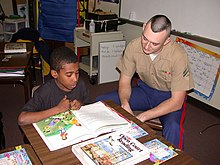
A U.S. Marine helps a student with reading comprehension as office of a Partnership in Education programme sponsored by Park Street Elementary School and Navy/Marine Corps Reserve Centre Atlanta. The program is a community out-reach program for sailors and Marines to visit the school and help students with form piece of work.
Reciprocal educational activity [edit]
In the 1980s Annemarie Sullivan Palincsar and Ann 50. Dark-brown developed a technique called reciprocal teaching that taught students to predict, summarize, clarify, and ask questions for sections of a text. The employ of strategies like summarizing after each paragraph accept come to be seen as constructive strategies for building students' comprehension. The idea is that students will develop stronger reading comprehension skills on their own if the teacher gives them explicit mental tools for unpacking text.[27]
Instructional conversations [edit]
"Instructional conversations", or comprehension through discussion, create college-level thinking opportunities for students by promoting critical and aesthetic thinking about the text. Co-ordinate to Vivian Thayer, class discussions help students to generate ideas and new questions. (Goldenberg, p. 317). Dr. Neil Postman has said, "All our knowledge results from questions, which is another way of saying that question-request is our nigh of import intellectual tool"[ citation needed ] (Response to Intervention). There are several types of questions that a teacher should focus on: remembering; testing understanding; application or solving; invite synthesis or creating; and evaluation and judging. Teachers should model these types of questions through "recall-alouds" before, during, and after reading a text. When a student tin relate a passage to an experience, some other book, or other facts nearly the world, they are "making a connexion." Making connections help students understand the author's purpose and fiction or not-fiction story.[28]
Text factors [edit]
In that location are factors, that once discerned, make it easier for the reader to understand the written text. Ane is the genre, like folktales, historical fiction, biographies or poetry. Each genre has its own characteristics for text structure, that in one case understood help the reader comprehend it. A story is composed of a plot, characters, setting, point of view, and theme. Informational books provide real world knowledge for students and have unique features such as: headings, maps, vocabulary, and an index. Poems are written in different forms and the most commonly used are: rhymed verse, haikus, free verse, and narratives. Poetry uses devices such equally: alliteration, repetition, rhyme, metaphors, and similes. "When children are familiar with genres, organizational patterns, and text features in books they're reading, they're meliorate able to create those text factors in their ain writing." Another ane is arranging the text per perceptual bridge and the text display favorable to the historic period level of the reader.[29]
Non-Verbal Imagery [edit]
Media that utilizes schema to make connections either planned or not, more usually used within context such equally: a passage, an experience, or one's imagination. Some notable examples are emojis, emoticons, cropped and uncropped images, and recently Imojis which are humorous, cropped images that are used to arm-twist humour and comprehension.[30]
Visualization [edit]
Visualization is a "mental image" created in a person's mind while reading text, which "brings words to life" and helps improve reading comprehension. Asking sensory questions will help students become amend visualizers.[28] Students can practice visualizing by imagining what they "see, hear, olfactory property, taste, or experience" when they are reading a page of a picture book aloud, merely not still shown the picture. They can share their visualizations, then check their level of detail against the illustrations.
Partner reading [edit]
Partner reading is a strategy created for pairs. The teacher chooses two appropriate books for the students to read. Showtime the pupils and their partners, must read their own volume. Once they have completed this, they are given the opportunity to write downwards their own comprehensive questions for their partner. The students swap books, read them out loud to 1 another and inquire i another questions about the book they read. There are different levels of this. There are the lower ones who demand extra assistance recording the strategies. The next level are the average merely, will still need some help. In that location is a good level where the children are skillful with no assist required. Finally a very adept level, where they are a few years ahead.
This strategy:
- Provides a model of fluent reading and helps students learn decoding skills by offering positive feedback.[31]
- Provides straight opportunities for a teacher to broadcast in the grade, observe students, and offer individual remediation.[31]
Multiple reading strategies [edit]
In that location are a wide range of reading strategies suggested by reading programs and educators. Effective reading strategies may differ for 2nd language learners, equally opposed to native speakers.[32] [33] [34] The National Reading Console identified positive effects only for a subset, especially summarizing, asking questions, answering questions, comprehension monitoring, graphic organizers, and cooperative learning. The Panel also emphasized that a combination of strategies, equally used in Reciprocal Pedagogy, tin be effective.[28] The use of effective comprehension strategies that provide specific instructions for developing and retaining comprehension skills, with intermittent feedback, has been found to improve reading comprehension across all ages, specifically those affected by mental disabilities.[35]
Reading dissimilar types of texts requires the use of different reading strategies and approaches. Making reading an agile, appreciable process can be very benign to struggling readers. A practiced reader interacts with the text in order to develop an understanding of the information before them. Some adept reader strategies are predicting, connecting, inferring, summarizing, analyzing and critiquing. In that location are many resources and activities educators and instructors of reading can use to help with reading strategies in specific content areas and disciplines. Some examples are graphic organizers, talking to the text, apprehension guides, double entry journals, interactive reading and note taking guides, chunking, and summarizing.[ commendation needed ]
The use of effective comprehension strategies is highly of import when learning to improve reading comprehension. These strategies provide specific instructions for developing and retaining comprehension skills across all ages.[35] Applying methods to attain an overt phonemic sensation with intermittent practice has been plant to better reading in early on ages, specifically those affected by mental disabilities.
Comprehension Strategies [edit]
Enquiry studies on reading and comprehension accept shown that highly proficient readers apply a number of different strategies to comprehend diverse types of texts, strategies that can besides be used by less proficient readers in order to improve their comprehension.
- Making Inferences: In everyday terms we refer to this as "reading between the lines". It involves connecting various parts of texts that aren't directly linked in order to form a sensible conclusion. A form of assumption, the reader speculates what connections prevarication within the texts.
- Planning and Monitoring: This strategy centers around the reader'due south mental awareness and their ability to control their comprehension by way of awareness. Past previewing text (via outlines, table of contents, etc.) one can establish a goal for reading-"what do I demand to get out of this"? Readers use context clues and other evaluation strategies to clarify texts and ideas, and thus monitoring their level of understanding.
- Asking Questions: To solidify one's understanding of passages of texts readers enquire and develop their ain stance of the author'south writing, grapheme motivations, relationships, etc. This strategy involves allowing oneself to be completely objective in order to find diverse meanings within the text.
- Determining Importance: Pinpointing the important ideas and messages inside the text. Readers are taught to place straight and indirect ideas and to summarize the relevance of each.
- Visualizing: With this sensory-driven strategy readers form mental and visual images of the contents of text. Existence able to connect visually allows for a better agreement with the text through emotional responses.
- Synthesizing: This method involves marrying multiple ideas from diverse texts in order to depict conclusions and make comparisons across unlike texts; with the reader's goal being to empathize how they all fit together.
- Making Connections: A cognitive approach also referred to equally "reading beyond the lines", which involves (A) finding a personal connection to reading, such as personal experience, previously read texts, etc. to help found a deeper understanding of the context of the text, or (B) thinking most implications that have no immediate connection with the theme of the text.[36]
Assessment [edit]
In that location are informal and formal assessments to monitor an individual'due south comprehension ability and use of comprehension strategies.[37] Breezy assessments are generally through observation and the utilize of tools, similar story boards, word sorts, and interactive writing. Many teachers utilize Formative assessments to determine if a educatee has mastered content of the lesson. Formative assessments can be exact as in a Think-Pair-Share or Partner Share. Formative Assessments can also be Ticket out the door or digital summarizers. Formal assessments are district or land assessments that evaluates all students on important skills and concepts. Summative assessments are typically assessments given at the end of a unit to measure a student's learning.
Running records [edit]

[38] Running Record Codes
A popular assessment undertaken in numerous chief schools around the world are running records. Running records are a helpful tool in regard to reading comprehension.[39] The tool assists teachers in analysing specific patterns in pupil behaviours and planning advisable instruction. By conducting running records teachers are given an overview of students reading abilities and learning over a flow of time.
In guild for teachers to conduct a running record properly, they must sit beside a student and make sure that the environment is as relaxed as possible so the educatee does not feel pressured or intimidated. It is best if the running record assessment is conducted during reading, so at that place are non distractions. Another alternative is asking an education banana to conduct the running record for you in a separate room whilst you teach/supervise the form. Quietly observe the students reading and record during this time. There is a specific code for recording which most teachers sympathise. Once the student has finished reading ask them to retell the story as best they can. After the completion of this, enquire them comprehensive questions listed to test them on their understanding of the book. At the stop of the assessment add up their running record score and file the assessment sail away. Afterward the completion of the running record assessment, plan strategies that volition improve the students' ability to read and sympathise the text.
Overview of the steps taken when conducting a Running Record assessment:[40]
- Select the text
- Innovate the text
- Take a running record
- Inquire for retelling of the story
- Ask comprehensive questions
- Check fluency
- Analyse the record
- Plan strategies to improve students reading/agreement power
- File results abroad
Difficult or complex content [edit]
Reading hard texts [edit]
Some texts, like in philosophy, literature or scientific research, may appear more difficult to read because of the prior knowledge they assume, the tradition from which they come, or the tone, such every bit criticizing or parodying.[ citation needed ] Philosopher Jacques Derrida, explained his stance about complicated text: "In society to unfold what is implicit in so many discourses, one would have each time to make a pedagogical outlay that is only not reasonable to expect from every book. Here the responsibility has to be shared out, mediated; the reading has to do its work and the piece of work has to make its reader."[41] Other philosophers, yet, believe that if you accept something to say, you should be able to brand the message readable to a broad audition.[ commendation needed ]
Hyperlinks [edit]
Embedded hyperlinks in documents or Internet pages have been found to make dissimilar demands on the reader than traditional text. Authors, such as Nicholas Carr, and psychologists, such as Maryanne Wolf, fence that the internet may accept a negative touch on attention and reading comprehension.[42] Some studies report increased demands of reading hyperlinked text in terms of cerebral load, or the amount of information actively maintained in 1's mind (also see working memory).[43] Ane study showed that going from about five hyperlinks per page to about 11 per page reduced college students' understanding (assessed by multiple choice tests) of manufactures about alternative energy.[44] This can be attributed to the decision-making process (deciding whether to click on information technology) required past each hyperlink,[43] which may reduce comprehension of surrounding text.
On the other mitt, other studies accept shown that if a curt summary of the link'southward content is provided when the mouse arrow hovers over information technology, and so comprehension of the text is improved.[45] "Navigation hints" well-nigh which links are virtually relevant improved comprehension.[46] Finally, the background knowledge of the reader can partially make up one's mind the effect hyperlinks have on comprehension. In a written report of reading comprehension with subjects who were familiar or unfamiliar with art history, texts which were hyperlinked to one another hierarchically were easier for novices to sympathise than texts which were hyperlinked semantically. In contrast, those already familiar with the topic understood the content equally well with both types of organization.[43]
In interpreting these results, information technology may exist useful to note that the studies mentioned were all performed in airtight content environments, not on the internet. That is, the texts used only linked to a predetermined fix of other texts which was offline. Furthermore, the participants were explicitly instructed to read on a certain topic in a limited corporeality of time. Reading text on the net may not accept these constraints.[ commendation needed ]
Professional evolution [edit]
The National Reading Panel noted that comprehension strategy instruction is hard for many teachers too as for students, particularly because they were non taught this way and because it is a enervating task. They suggested that professional development can increase teachers/students willingness to utilise reading strategies only admitted that much remains to be done in this area.[ citation needed ] The directed listening and thinking action is a technique available to teachers to help students in learning how to un-read and reading comprehension. It is also difficult for students that are new. There is oftentimes some debate when considering the relationship between reading fluency and reading comprehension. There is evidence of a direct correlation that fluency and comprehension lead to better agreement of the written material, across all ages.[ commendation needed ] The National Assessment of Educational Progress assessed U.S. pupil functioning in reading at form 12 from both public and private school population and institute that only 37 per centum of students were having proficient skills. The bulk, 72 per centum of the students were just at or above bones skills, and alarmingly a 28 percentage of the students were below basic level.[47]
See also [edit]
- Balanced literacy
- Directed listening and thinking activity
- English as a second or foreign language
- Fluency
- Levels-of-processing
- Phonics
- Readability
- Reading
- Reading for special needs
- Simple view of reading
- Synthetic phonics
- Whole language
References [edit]
- ^ "What is Reading Comprehension?". Reading Worksheets, Spelling, Grammar, Comprehension, Lesson Plans. 2008-05-29. Archived from the original on 2016-05-09. Retrieved 2016-05-xiii .
- ^ William Grabe (2009). Reading in a Second Language: Moving from Theory to Do. Cambridge University Printing. ISBN978-0-521-72974-one. Archived from the original on 2018-05-04.
Koda, 2005:4
- ^ Davis, Frederick B. (September 1944). "Key factors of comprehension in reading". Psychometrika. 9 (iii): 185–197. doi:ten.1007/BF02288722. S2CID 67849226.
- ^ Commission on Learning Sciences: Foundations and Applications to Boyish and Developed Literacy; Division of Behavioral and Social Sciences and Education; National Research Council (2012). Improving Adult Literacy Didactics: Options for Practice and Enquiry. National Academies Printing. p. 41. ISBN978-0-309-21960-0. Archived from the original on 2018-05-04.
- ^ Maryanne Wolf (2016). Tales of Literacy for the 21st Century: The Literary Agenda. OUP Oxford. ISBN978-0-19-103613-2.
- ^ Tompkins, K.E. (2011). Literacy in the early grades: A successful offset for prek-four readers (third edition), Boston, Pearson. pp. 5, 7.
- ^ Adams, Marilyn McCord (1994). Start to read: thinking and learning nearly print . Cambridge, Mass: MIT Printing. ISBN978-0-262-51076-9. OCLC 62108874.
Beginning to Read: Thinking and Learning nearly Print.
- ^ Tompkins, G.E. (2011). Literacy in the early on grades: A successful start for prek-4 readers (3rd edition), Boston, Pearson. pp. 205, 208–209, 211–212.
- ^ Ula C. Manzo; Anthony V. Manzo (1993). Literacy Disorders: Holistic Diagnosis and Remediation. LiteracyLeaders. p. 26. ISBN978-0-03-072633-0.
- ^ "Effect of overlearning on retention". psycnet.apa.org . Retrieved 2019-11-xix .
- ^ Richard R. Day; Julian Bamford (1998). Extensive Reading in the Second Language Classroom. Cambridge University Press. ISBN978-0-521-56829-6.
- ^ Keith Rayner; Barbara Foorman; Charles Perfetti; David Pesetsky & Mark Seidenberg (November 2001). "How Psychological Science Informs the Teaching of Reading". Psychological Science in the Public Interest. 2 (ii): 31–74. CiteSeerX10.one.1.14.4083. doi:x.1111/1529-1006.00004. PMID 26151366. S2CID 134422.
- ^ Tompkins, G.E. (2011). Literacy in the early grades: A successful start for prek-4 readers (3rd edition), Boston, Pearson. p 203.
- ^ Tompkins, G.E. (2011). Literacy in the early grades: A successful start for prek-4 readers (tertiary edition), Boston, Pearson. p 37
- ^ Richard K. Wagner; Christopher Schatschneider; Caroline Phythian-Sence (nineteen June 2009). Beyond Decoding: The Behavioral and Biological Foundations of Reading Comprehension. Guilford Printing. pp. 143–175. ISBN978-1-60623-356-6.
- ^ Speer, Nicole; Yarkoni, Tal; Zacks, Jeffrey (2008). "Neural substrates of narrative comprehension and retentiveness". NeuroImage. 41 (iv): 1408–1425. doi:10.1016/j.neuroimage.2008.03.062. PMC2580728. PMID 18499478.
- ^ Usha Goswami (2011). The Wiley-Blackwell Handbook of Childhood Cognitive Development. John Wiley & Sons. pp. 342+. ISBN978-1-4443-5173-6. Archived from the original on 2018-05-04.
- ^ David A. Sousa (eight August 2011). How the Brain Learns. SAGE Publications. pp. 193+. ISBN978-1-4522-7775-2.
- ^ Nielsen, Diane. "Study shows greater focus on vocabulary tin help brand students better readers". news.ku.edu. The University of Kansas. Archived from the original on 3 February 2013. Retrieved 15 March 2013.
if they don't sympathise the meaning of the words, then their ability to sympathize the overall pregnant of a story or other text will be compromised
- ^ Tompkins, G.E. (2011). Literacy in the early on grades: A successful start for prek-4 readers (3rd edition), Boston, Pearson. pp. 171, 181, 183.
- ^ Biemiller & Boote, 2006
- ^ Linda Kucan; Beck, Isabel L.; McKeown, Margaret Thousand. (2002). Bringing words to life: robust vocabulary instruction . New York: Guilford Press. ISBN978-one-57230-753-7. OCLC 48450880.
- ^ Matthew M. Thomas; Manzo, Anthony 5.; Manzo, Ula Casale (2005). Content area literacy: strategic teaching for strategic learning. New York: Wiley. pp. 163–four. ISBN978-0-471-15167-eight. OCLC 58833339.
- ^ Robinson, Francis Pleasant (1978). Constructive Written report (6th ed.). New York: Harper & Row. ISBN978-0-06-045521-7.
- ^ "Reading and Questioning: The Request Process - ProQuest". search.proquest.com . Retrieved 2018-x-14 .
- ^ Pearson, P. David. "The Roots of Reading Comprehension Education" (PDF). postgradolinguistica.ucv.cl. University of California, Berkeley. Archived (PDF) from the original on 18 December 2013. Retrieved 15 March 2013.
- ^ a b Pressley, Michael (2006). Reading didactics that works: the case for balanced teaching. New York: Guilford Printing. ISBN1-59385-229-0. OCLC 61229782. Archived from the original on 2018-05-04.
- ^ a b c Dan Bong, The GRE Handbook - The How to on GRE, Consummate Expert's Hints and Tips Guide by the Leading Experts, Everything You Need to Know about GRE, p.68
- ^ Tompkins, G.E. (2011). Literacy in the early on grades: A successful start for prek-4 readers (tertiary edition), Boston, Pearson. p. 249.
- ^ Vargas, Evan (Summertime 2016). "Ha-Ha, I'one thousand Comprehending With Imojis" (PDF). Colorado Reading Journal. 27: 16–19. Archived (PDF) from the original on 2017-08-30.
- ^ a b "Partner Reading". Reading Rockets. Archived from the original on 2016-05-06. Retrieved 2016-05-13 .
- ^ Tanyeli, Nadıran (2009). "The efficiency of online English language instruction on students' reading skills". Procedia - Social and Behavioral Sciences. one (1): 564–567. doi:ten.1016/j.sbspro.2009.01.102.
- ^ Iwai, Yuko (Summer 2008). "The Perceptions of Japanese Students toward Academic English Reading: Implications for Effective ESL Reading Strategies". Multicultural Education; San Francisco. 15 (4): 45–50. ProQuest 216511645 Gale A184800662 ERIC EJ809075.
- ^ Deacon, South. Hélène; Wade-Woolley, Lesly; Kirby, John R. (May 2009). "Flexibility in young second-language learners: examining the language specificity of orthographic processing". Journal of Research in Reading. 32 (2): 215–229. doi:10.1111/j.1467-9817.2009.01392.x.
- ^ a b Berkeley, Sheri; Mastropieri, Margo A.; Scruggs, Thomas Due east. (January 2011). "Reading Comprehension Strategy Instruction and Attribution Retraining for Secondary Students With Learning and Other Mild Disabilities". Journal of Learning Disabilities. 44 (one): 18–32. doi:x.1177/0022219410371677. PMID 21335506. S2CID 22697420.
- ^ "Speed Reading Tip: A Study on 7 Reading Strategies To Read More than Proficiently - Read Write Work". speedreadinfo.com. fifteen Baronial 2016. Archived from the original on 28 April 2017. Retrieved iv May 2018.
- ^ Tompkins, G.East. (2011). Literacy in the early on grades: A successful first for prek-four readers (3rd edition), Boston, Pearson.[ page needed ]
- ^ "How to have running records" (PDF). Scholastic. Scholastic Canada Ltd. 2002. Archived (PDF) from the original on 2017-01-10. Retrieved 2016-05-xiii .
- ^ How To Have Running Records. Canada: Scholastic Canada Ltd. 2002. p. 1.
- ^ n/a, n/a (2002). How to take running records. Canada: Scholastic Canada Ltd. pp. 9–xi.
- ^ Jacques Derrida (1987) Heidegger, the Philosopher's Hell, interview past Didier Eribon for Le Nouvel Observateur upshot of November 6–12, republished in Points: Interviews 1974-1994 (1995) pp.187-8
- ^ Nicholas G. Carr (2010). The shallows: what the Cyberspace is doing to our brains . New York: Due west.West. Norton. ISBN978-0-393-07222-8. OCLC 449865498.
- ^ a b c DeStefano, Diana; LeFevre, Jo-Anne (1 May 2007). "Cerebral load in hypertext reading: A review". Computers in Homo Behavior. 23 (3): 1616–1641. doi:10.1016/j.chb.2005.08.012.
- ^ Zhu, Erping (1 September 1999). "Hypermedia interface design: the effects of number of links and granularity of nodes". Periodical of Educational Multimedia and Hypermedia. 8 (three): 331–358.
- ^ Antonenko, Pavlo D.; Niederhauser, Dale South. (March 2010). "The influence of leads on cognitive load and learning in a hypertext environment". Computers in Human Behavior. 26 (2): 140–150. doi:10.1016/j.chb.2009.10.014.
- ^ Ignacio Madrid, R.; Van Oostendorp, Herre; Puerta Melguizo, Mari Carmen (1 January 2009). "The furnishings of the number of links and navigation back up on cognitive load and learning with hypertext: The mediating role of reading order". Computers in Human Behavior. 25 (i): 66–75. doi:10.1016/j.chb.2008.06.005.
- ^ "Reading Functioning" (PDF). Archived (PDF) from the original on 2017-08-31. Retrieved 2018-03-07 .
Further reading [edit]
- Heim S, Friederici Ad (November 2003). "Phonological processing in linguistic communication product: time course of encephalon activity". NeuroReport. fourteen (16): 2031–three. doi:10.1097/00001756-200311140-00005. hdl:11858/00-001M-0000-0010-D0B5-vii. PMID 14600492.
- Vigneau M, Beaucousin V, Hervé PY, et al. (May 2006). "Meta-analyzing left hemisphere language areas: phonology, semantics, and judgement processing". NeuroImage. thirty (4): 1414–32. doi:10.1016/j.neuroimage.2005.11.002. PMID 16413796. S2CID 8870165.
External links [edit]
- Info, Tips, and Strategies for PTE Read Aloud, Limited English Linguistic communication Training Heart
- English Reading Comprehension Skills, Andrews University
- Vocabulary Instruction and Reading comprehension - From the ERIC Clearinghouse on Reading English and Communication.
- ReadWorks.org | The Solution to Reading Comprehension
- Tips on improving Reading Comprehension Skills
- Improving reading fluency
Source: https://en.wikipedia.org/wiki/Reading_comprehension
0 Response to "A Word for Reading Matetrial in Order Yo Make a Decision"
Post a Comment